ONCOLOGY: ENPP1
Our potential ENPP1 inhibitors target a key immune evasion mechanism
The immune system detects and attacks cancer in part via a signaling molecule called cGAMP. Damaged cancer cells release cGAMP, which activates the STING pathway and triggers an innate immune response that turns “cold” tumors “hot.” This attracts T cells and other immune cells that then attack the tumor. However, an enzyme called ENPP1 can degrade cGAMP and thus silence the alarm signal and protect the tumor. High ENPP1 expression is linked to worse outcomes (shorter disease-free survival, increased rate of metastases) in multiple cancers, including colon (where high ENPP1 expression is seen in 6% of cases), lung (5%), pancreas (5%), and breast (4%). Because ENPP1 activity is such a dominant mechanism for degrading cGAMP, it is a particularly attractive checkpoint for immune reactivation.
Because high ENPP1 inhibits the immune system, ENPP1 inhibition could spur immune activation
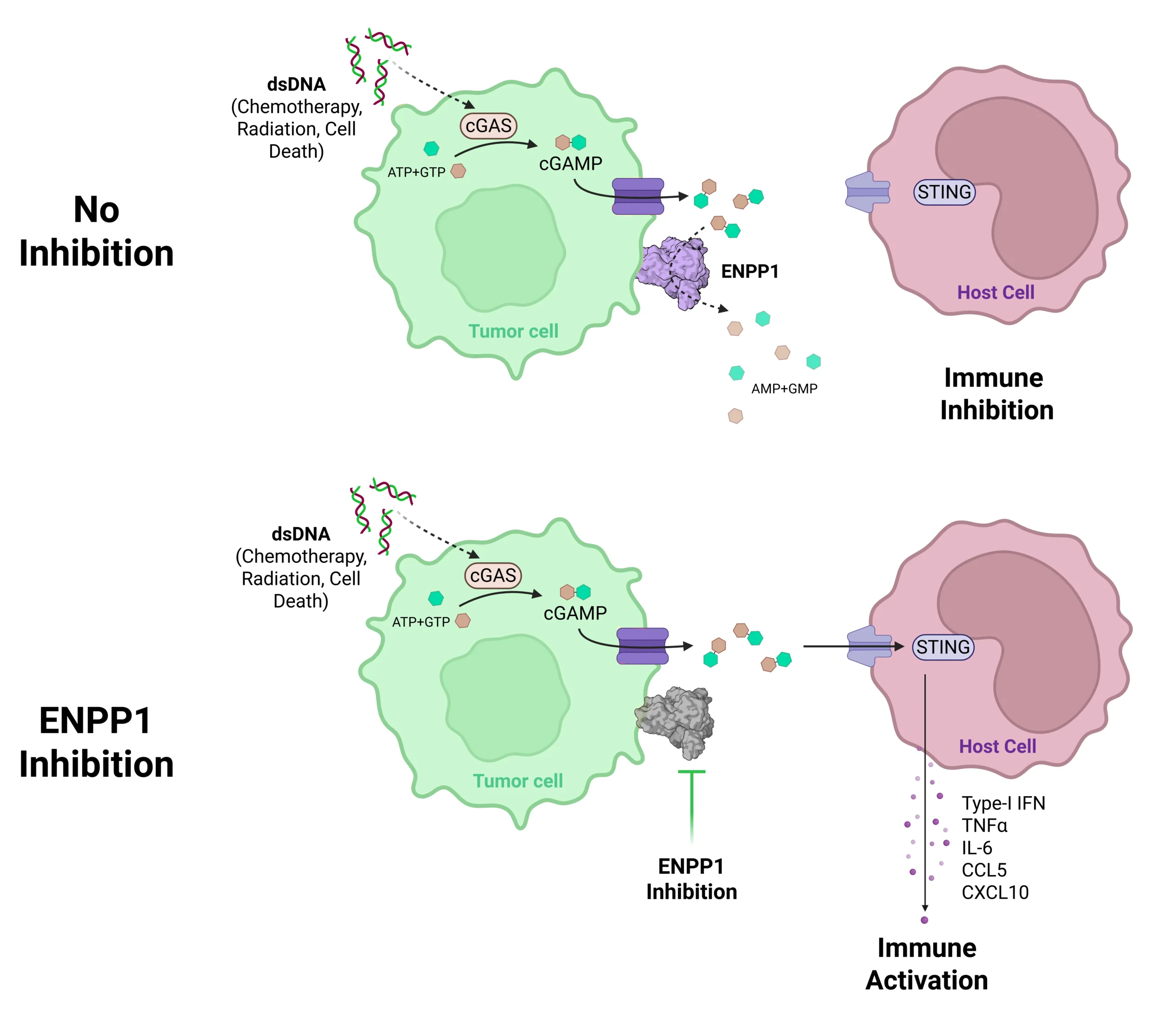
Highly potent, boron-based ENPP1 inhibitors are intended to activate the immune system
Preclinical highlights
Single-agent efficacy comparable to PD-1 and CTLA-4 checkpoint inhibitors (multiple tumor models).
Synergistic effects when combined with anti-CTLA-4 (complete response rate was tripled in a colorectal cancer model).
Durable tumor regression with immune memory, resisting re-challenge by the same cancer cells.


Our boron-based ENPP1 inhibitors, including AN2-503321, are designed to act as phosphate mimetics, binding to metal ions in ENPP1’s active site with high potency and excellent drug-like properties. Boron’s ability to mimic phosphate groups gives our inhibitors an advantage in binding the metal-coordinated active site of ENPP1, a site historically challenging for small-molecule inhibitors. This chemistry also supports oral bioavailability and strong intellectual property positioning in a competitive target space. We plan to nominate a development candidate in 2025, and be Phase 1-ready by the second half of 2026. This development candidate could potentially be used both as monotherapy for ENPP1-high tumors and in combination regimens with checkpoint inhibitors, PARP inhibitors, chemotherapy, ADCs, and radiation therapy.